The internet contains billions of web pages, and every second, search engines process millions of searches to help users find the information they need. Whether you’re looking for a nearby restaurant, researching a product, or learning a new skill, search engines make it possible to discover the most relevant content within seconds.
But have you ever wondered how search engines know which websites to show first?
The answer lies in three fundamental processes: crawling, indexing, and ranking. These processes help search engines discover new content, organize it, and determine which pages best answer a user’s query.
If you own a website, blog, or online business, understanding these search engine basics is essential. The better you understand how search engines work, the easier it becomes to optimize your website for higher rankings and increased organic traffic.
In this comprehensive guide, you’ll learn:
- What search engines are
- Why search engines are important
- Different types of search engines
- How search engines crawl websites
- How indexing works
- How search engines rank web pages
- Best practices to prepare your website for search engines
Let’s begin with the basics.
What Are Search Engines?
A search engine is an online software system designed to help users find information on the internet. Instead of manually browsing millions of websites, users simply type a keyword or question into a search box, and the search engine returns the most relevant web pages.
Search engines continuously explore the web, collect information about websites, and organize that information into massive databases known as indexes.
When someone performs a search, the search engine quickly scans its index and displays results that best match the user’s intent.
Some of the world’s most popular search engines include:
- Bing
- Yahoo
- DuckDuckGo
- Baidu
- Yandex
Although Google dominates the global search market, every search engine follows a similar workflow:
- Discover web pages (Crawling)
- Store information (Indexing)
- Rank pages based on relevance and quality (Ranking)
Why Are Search Engines Important?
Search engines have become the gateway to the internet. They help users find answers quickly while helping businesses connect with potential customers.
Without search engines, discovering useful websites would be slow and inefficient.
Some key benefits of search engines include:
Quick Access to Information
Search engines organize billions of web pages so users can instantly find articles, videos, products, services, and other resources.
Increased Website Visibility
Businesses rely on search engines to attract visitors without paying for every click through advertising.
Better User Experience
Modern search engines prioritize websites that provide useful, trustworthy, and high-quality content.
Business Growth
Appearing on the first page of search results can significantly increase website traffic, brand awareness, and sales.
Types of Search Engines
Not all search engines work exactly the same way. Depending on their purpose, they can be grouped into several categories.
1. Traditional Search Engines
Traditional search engines crawl billions of web pages and display results based on relevance and authority.
Examples include:
- Bing
- Yahoo
These search engines are used for general web searches.
2. Vertical Search Engines
Vertical search engines focus on a specific type of content or industry instead of the entire web.
Examples include:
- YouTube (Videos)
- Amazon (Products)
- LinkedIn (Professional profiles and jobs)
- Pinterest (Images and inspiration)
These platforms have their own search algorithms designed for specialized content.
3. AI-Powered Search Engines
Artificial intelligence is changing how people search online.
Instead of only displaying a list of links, AI search engines can summarize information, answer questions directly, and provide conversational responses.
Examples include:
- ChatGPT Search
- Perplexity AI
- Google AI-powered Search experiences
- Microsoft Copilot
As AI continues to evolve, website owners need to optimize content not only for traditional search engines but also for AI-driven search experiences.
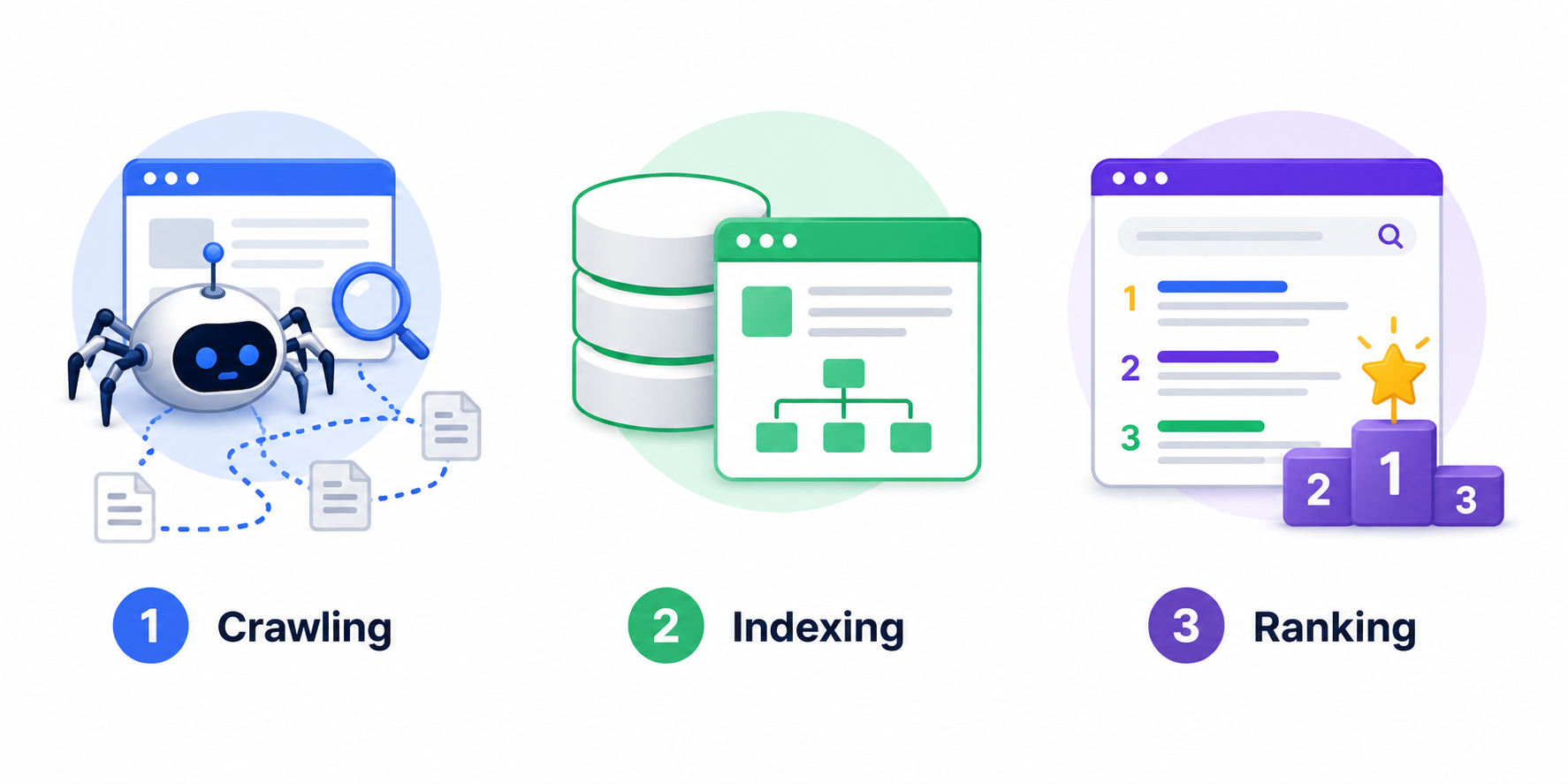
The Three Pillars of Search Engines
Every search engine follows three essential stages before displaying results.
They are:
- Crawling
- Indexing
- Ranking
Let’s explore each process in detail.
What Is Crawling?
Crawling is the process where search engines discover new and updated web pages.
To accomplish this, search engines use automated software programs known as:
- Web crawlers
- Search bots
- Search spiders
- Crawling bots
These bots continuously travel across the internet by following hyperlinks from one page to another.
For example:
A crawler visits your homepage.
↓
It discovers links to your blog.
↓
It opens every blog post.
↓
It follows links within those articles.
↓
It continues discovering additional pages.
This process repeats continuously across billions of websites.
How Search Engine Crawlers Discover Content
Search engines find new pages through several methods.
Internal Links
Pages connected through your website’s navigation are easier for crawlers to discover.
Backlinks
Links from other websites help search engines find new pages faster.
XML Sitemaps
An XML sitemap acts as a roadmap that lists important URLs on your website.
Previously Indexed Pages
When search engines revisit existing pages, they often discover newly added links.
What Information Does a Crawler Collect?
During crawling, search engines collect information such as:
- Page title
- Meta description
- Headings
- Images
- Videos
- Internal links
- External links
- Structured data
- Canonical tags
- Mobile compatibility
- Loading speed
This information helps determine whether a page should be indexed.
Factors That Affect Crawling
Several website issues can make crawling more difficult.
These include:
Broken Links
Dead links waste crawl resources and prevent bots from discovering valuable content.
Poor Website Structure
A confusing navigation system can hide important pages from search engines.
Slow Website Speed
Extremely slow websites reduce crawl efficiency.
Robots.txt Restrictions
Improper settings may accidentally block important pages.
Duplicate URLs
Too many duplicate pages can confuse search engine crawlers.
Best Practices for Better Crawling
To make your website easier to crawl:
- Create an XML sitemap.
- Use descriptive internal links.
- Fix broken links regularly.
- Improve website speed.
- Maintain a logical site hierarchy.
- Avoid orphan pages (pages with no internal links).
- Use robots.txt carefully.
- Keep navigation simple and organized.
The easier your website is to crawl, the faster search engines can discover new content.
What Is Indexing?
After a page has been crawled, the next step is indexing.
Indexing is the process of storing and organizing information in the search engine’s database.
Think of it like a giant digital library.
Every webpage that passes quality checks may be added to the index, where it can later appear in search results.
If your page isn’t indexed, users won’t find it through organic search—even if the content is excellent.
How Search Engines Index Content
When evaluating a page for indexing, search engines analyze several elements:
- Page content
- Keyword relevance
- Content originality
- Images
- Videos
- Structured data
- Internal linking
- Metadata
- Mobile usability
- Page quality
The goal is to understand what the page is about and whether it offers value to users.
Why Pages May Not Be Indexed
Not every crawled page is added to the index.
Common reasons include:
- Thin or low-quality content
- Duplicate pages
- “Noindex” meta tags
- Blocked by robots.txt
- Soft 404 errors
- Server issues
- Poor user experience
Creating valuable, unique content increases the chances of successful indexing.
What Is Ranking?
Ranking is the process of determining the order in which web pages appear on a Search Engine Results Page (SERP). After a page has been crawled and indexed, search engines evaluate it against hundreds of ranking signals to decide how relevant and valuable it is for a user’s search query.
For example, if someone searches for “best running shoes”, the search engine doesn’t display pages randomly. Instead, it analyzes all relevant indexed pages and ranks them based on factors like content quality, relevance, authority, and user experience.
The higher your page ranks, the more likely users are to click on it. Studies consistently show that the first few organic results receive the majority of search traffic, making ranking a key goal for any website owner.
How Search Engines Rank Websites
Search engines use advanced algorithms powered by machine learning and artificial intelligence to rank web pages. These algorithms consider hundreds of factors, but the core objective remains the same: deliver the most helpful and relevant results to users.
Some of the most important ranking signals include:
- Content quality
- Search intent
- Keyword relevance
- Website authority
- Backlinks
- User experience
- Mobile friendliness
- Page speed
- HTTPS security
- Freshness of content
- Technical SEO
- Internal linking
Let’s explore these in more detail.
Search Engine Ranking Factors
1. High-Quality Content
Content is one of the strongest ranking factors. Search engines prioritize pages that provide accurate, original, and useful information.
High-quality content should:
- Answer the user’s question completely
- Be well-organized and easy to read
- Include reliable information
- Demonstrate expertise
- Stay updated with current information
Avoid publishing thin, duplicate, or AI-generated content without human review, as it may fail to meet user expectations.
2. Search Intent
Search intent refers to the reason behind a user’s search.
For example:
| Search Query | User Intent |
| What is SEO? | Learn information |
| Buy laptop online | Make a purchase |
| Facebook login | Navigate to a website |
| Best DSLR camera | Compare products |
Creating content that aligns with the user’s intent significantly improves your chances of ranking well.
3. Keyword Relevance
Keywords help search engines understand the topic of your content.
To optimize your pages:
- Include your primary keyword in the title.
- Use it naturally in headings.
- Mention it in the introduction.
- Add related keywords throughout the content.
- Avoid keyword stuffing.
Modern search engines also understand synonyms and related phrases, so write naturally instead of repeating the same keyword excessively.
4. Website Authority
Search engines are more likely to trust websites that consistently publish valuable content and receive recognition from other reputable websites.
Authority is built over time through:
- Helpful content
- Positive user engagement
- High-quality backlinks
- Brand recognition
- Consistent publishing
A website with strong authority is more likely to rank for competitive keywords.
5. Backlinks
Backlinks are links from other websites pointing to your pages.
Search engines view quality backlinks as endorsements. If trusted websites link to your content, it signals that your page is valuable and credible.
Focus on earning backlinks through:
- Original research
- Helpful guides
- Guest blogging
- Digital PR
- Shareable infographics
Avoid buying links or participating in link schemes, as these practices can harm your rankings.
6. User Experience (UX)
A positive user experience encourages visitors to stay on your website and engage with your content.
Key UX factors include:
- Easy navigation
- Readable fonts
- Clear page structure
- Fast loading pages
- Mobile-friendly design
- Minimal intrusive pop-ups
Good UX benefits both users and search engines.
7. Page Speed
Users expect websites to load quickly. Slow pages can lead to higher bounce rates and lower engagement.
Improve page speed by:
- Compressing images
- Using browser caching
- Minimizing CSS and JavaScript
- Choosing reliable hosting
- Enabling content delivery networks (CDNs)
Fast websites provide a better experience and can support improved search visibility.
8. Mobile Friendliness
With most searches now happening on mobile devices, responsive design is essential.
A mobile-friendly website should:
- Adapt to different screen sizes
- Use readable text
- Have touch-friendly buttons
- Load quickly on mobile networks
Search engines prioritize websites that perform well across all devices.
9. HTTPS Security
Websites using HTTPS encrypt data exchanged between users and the server.
Benefits include:
- Improved security
- Increased user trust
- Protection of sensitive information
Using HTTPS is a standard best practice for modern websites.
10. Content Freshness
For many topics, search engines prefer recently updated content.
Keep your articles fresh by:
- Updating statistics
- Refreshing examples
- Adding new sections
- Removing outdated information
- Improving internal links
Regular updates signal that your content remains relevant.
All of these things optimize with right SEO strategy. A right seo strategy will help to rank your wensite on top pages of search engines.
E-E-A-T: Building Trust and Credibility
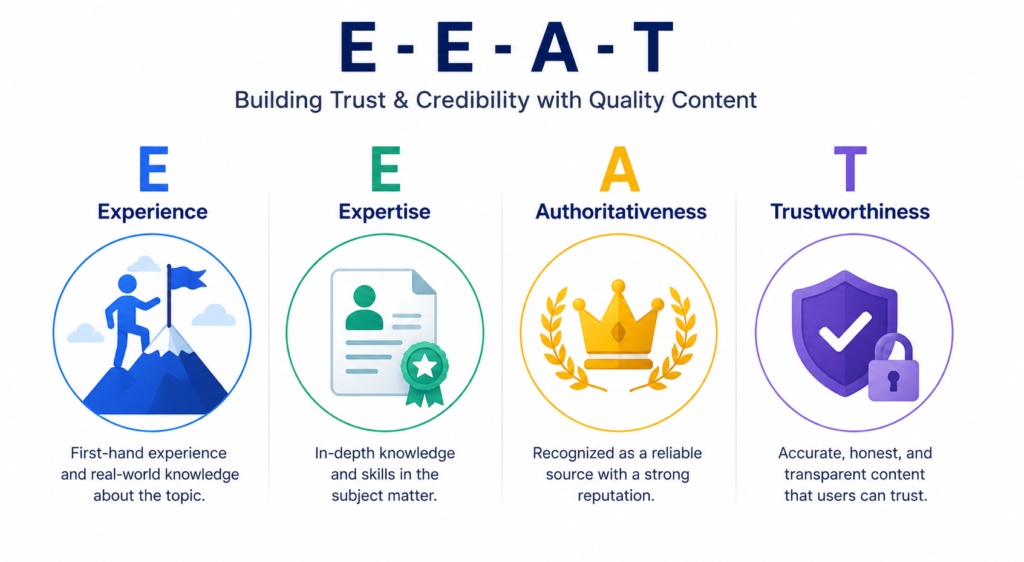
Search engines aim to surface content that users can trust. One framework often discussed in SEO is E-E-A-T, which stands for:
- Experience – First-hand knowledge or practical involvement with the topic.
- Expertise – Demonstrated subject matter knowledge.
- Authoritativeness – Recognition as a reliable source within the industry.
- Trustworthiness – Accuracy, transparency, and reliability of the content and website.
Ways to improve E-E-A-T include:
- Publishing well-researched content
- Citing credible sources
- Displaying author information
- Keeping content accurate and updated
- Providing clear contact and business information where appropriate
Crawling vs. Indexing vs. Ranking
Understanding the differences between these three stages is essential.
| Process | What Happens? | Purpose |
| Crawling | Search engine bots discover new and updated pages. | Find content on the web. |
| Indexing | Pages are analyzed and stored in the search engine’s database. | Make content eligible to appear in search results. |
| Ranking | Indexed pages are evaluated and ordered for a specific search query. | Show the most relevant results first. |
Think of it like a library:
- Crawling is collecting books.
- Indexing is organizing books on shelves.
- Ranking is recommending the best books based on a reader’s request.
The Future of Search Engines
Search technology continues to evolve, and SEO strategies must evolve with it.
AI-Powered Search
Artificial intelligence is transforming how search engines understand questions and deliver answers.
Content should focus on:
- Expertise
- Clear structure
- Comprehensive answers
- Trustworthy information
AI Mode SEO is redefining search. Explore smarter rank tracking tools to measure your performance across AI-powered search experiences.
Voice Search
More users are searching using voice assistants.
Optimize for conversational queries such as:
- “What is SEO optimization?”
- “How do search engines work?”
- “How can I improve SEO?”
Visual Search
Tools like Google Lens allow users to search using images instead of text.
Optimize image filenames, alt text, and quality to improve visibility in visual search.
Zero-Click Searches
Many search results now provide answers directly on the results page through featured snippets, knowledge panels, and AI-generated summaries.
To increase your chances of appearing in these results:
- Answer questions clearly.
- Use structured headings.
- Include lists and tables.
- Add FAQ sections.
- Implement structured data where appropriate.
Conclusion
Understanding how search engines work is the foundation of successful SEO. Every webpage goes through three essential stages crawling, indexing, and ranking before it can appear in search results. By learning how these processes work, you can create content and optimize your website in ways that make it easier for search engines to discover, understand, and rank your pages.
Effective Search Engine Optimization goes beyond simply using keywords. It involves publishing high-quality, user-focused content, maintaining a well-structured website, improving page speed, ensuring mobile friendliness, building authority through quality backlinks, and keeping your content updated. As search engines continue to evolve with AI and increasingly prioritize user experience, websites that provide accurate, trustworthy, and valuable information will have the best chance of achieving long-term success.
Whether you’re a beginner, blogger, business owner, or digital marketer, mastering these search engine basics will help you build a stronger online presence, attract more organic traffic, and stay competitive in an ever-changing search landscape.
FAQs
How do search engines find new websites?
Search engines discover new websites through links from other websites, XML sitemaps, URL submissions, and by revisiting previously indexed pages. Strong internal linking and backlinks help search engine bots find your content faster.
What is the difference between crawling, indexing, and ranking?
Crawling is the process of discovering web pages. Indexing is storing and organizing those pages in a search engine’s database. Ranking determines the order in which indexed pages appear in search results based on relevance and quality.
How often do search engines crawl a website?
There is no fixed schedule. Popular websites with frequently updated content may be crawled multiple times a day, while smaller websites may be crawled less often. Factors such as website authority, content freshness, and server performance influence crawl frequency.
Why is my website not appearing in Google search results?
A website may not appear in search results if it hasn’t been indexed, is blocked by robots.txt or a noindex tag, contains low-quality or duplicate content, or has technical SEO issues. Using Google Search Console can help identify indexing problems.
Can a webpage be crawled but not indexed?
Yes. A page can be successfully crawled but not added to Google’s index if it lacks valuable content, is duplicated, contains technical issues, or doesn’t meet Google’s quality standards.